The actual product may vary from the images shown on the website.
Red dry
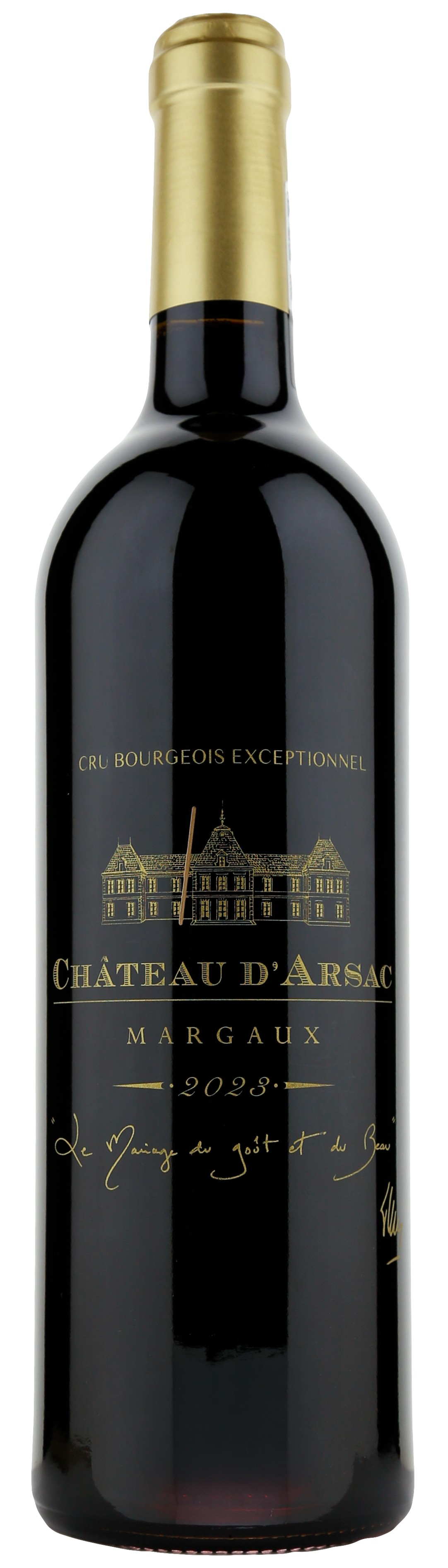
“Château d’Arsac” 2023 is a Margaux AOC wine classified as “Cru Bourgeois Exceptionnel”, dominated by 'Cabernet Sauvignon'. The 2023 vintage stands out for its fresh fruit character, vibrant acidity and soft, well-integrated tannins.
The nose is marked by black fruit aromas, particularly blackcurrant. As the wine opens, smoky, ashy and lightly toasted, empyreumatic notes emerge, adding depth to the fruit profile.
The palate is fresh and crisp at first, becoming fuller and softly velvety with time. The tannins are well integrated, giving the wine structure without becoming harsh. The finish is long, pronounced and fruit-driven, while the acidity maintains the wine’s freshness.
The wine is made from grapes grown in the “Château d’Arsac” Margaux vineyard, where deep gravel layers lie over brown soils with marl and limestone outcrops. In 2023, the grapes were fermented in temperature-controlled stainless-steel tanks and macerated for 3–4 weeks. 80% of the wine was aged in French oak barrels, 55% of which were new and 45% used for one vintage, while the remaining 20% was aged in stainless-steel tanks.
Serve at a temperature of 16–18 °C; pair with beef steak, duck breast, or aged hard cheeses.
“Château d’Arsac” is one of the oldest wine estates in the Médoc, with a history dating back to the 12th century. The first records of the estate date from the period when it belonged to the Lords of Arsac. In the 16th century, it passed to Thomas de Montaigne, the brother of the famous philosopher Michel de Montaigne. By the 18th century, 'Merlot' and 'Cabernet Sauvignon' were already being cultivated here, and wine production had become an important part of the estate.
At the beginning of the 20th century, “Château d’Arsac” was the largest vineyard in the Médoc, but the phylloxera crisis destroyed all the vines and the vineyard was completely uprooted. When the boundaries of the Margaux appellation were established in 1954, the abandoned estate was not included. For many years, “Château d’Arsac” remained with almost no vineyard until it was acquired in 1986 by Philippe Raoux, a Bordeaux wine merchant. He began a large-scale restoration of the estate, replanting the vineyards, restoring the historic buildings and modernising the winemaking facilities.
This revival went beyond wine. Philippe Raoux turned “Château d’Arsac” into a place where wine and contemporary art coexist. A new work of art is acquired every year, while the estate has built up a monumental collection of contemporary art. Art here is not simply decoration – it has become part of the estate’s new identity after several decades of decline and abandonment.
The identity of “Château d’Arsac” today is therefore shaped not only by the history of the Médoc, but also by the estate’s restoration, which began in the late 20th century. This is one of the reasons why the estate stands out among the wineries of Margaux today.
Today, the vineyards of “Château d’Arsac” cover around 90 hectares: 54 hectares belong to the Margaux AOC, 32 hectares to the Haut-Médoc AOC, while a further 4 hectares are devoted to “Bordeaux Blanc” wines made from 'Sauvignon Blanc'. The vineyards are planted on sandy gravel soils formed from alluvial deposits, with clay subsoil. The deep gravel layers provide good drainage, while the nearby Gironde estuary helps moderate temperature fluctuations in the Médoc climate.
The red wines are based on 'Cabernet Sauvignon' and 'Merlot'. The vineyards are managed through targeted viticultural practices, including pruning, shoot thinning, leaf removal, yield regulation and careful grape selection. Since 2018, the estate has followed a “zero pesticide residues” policy, favouring preventive vineyard management practices over chemical treatments. Grapes are harvested both by hand and mechanically, depending on the individual plot and vintage conditions.
An important milestone for “Château d’Arsac” came in 2020, when its Margaux wine was awarded “Cru Bourgeois Exceptionnel” status. This is the highest level of the Crus Bourgeois du Médoc classification.
“Château d’Arsac” is overseen by winemaking consultant Éric Boissenot, with each vintage produced according to the character of the individual plots. This is particularly important in the Margaux terroir, where gravel, clay, drainage and the microclimate influenced by the Gironde estuary together contribute to the ripening of 'Cabernet Sauvignon' and the structure of the wine.
What makes “Château d’Arsac” particularly interesting today is this contrast: it is not a classic Bordeaux estate that has preserved an uninterrupted tradition over centuries, but a historic estate that was essentially rebuilt after a period of complete decline.