The actual product may vary from the images shown on the website.
Red dry
Expected arrival – July
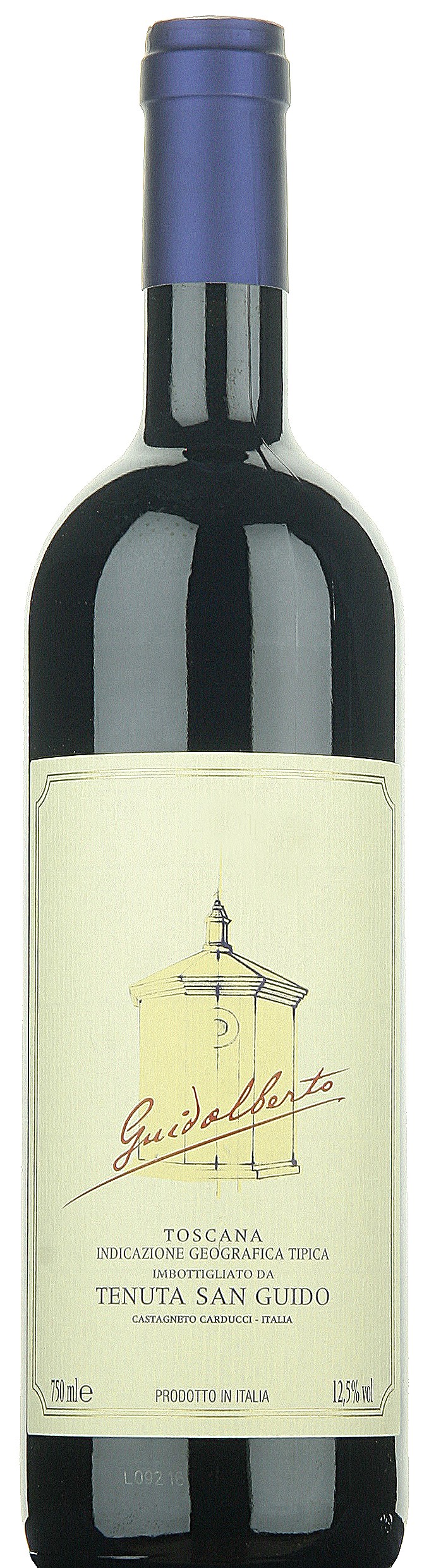
Guidalberto Toscana 2024 is an attempt to create a wine whose potential unfolds slightly earlier than that of the iconic Sassicaia.
The result is a structured yet earlier-drinking Tuscan wine that retains the signature Tenuta San Guido style. It is crafted by combining the character of Bordeaux varieties (Merlot and Cabernet Sauvignon) with a softer, more approachable expression in its youth.
The bouquet shows ripe red fruits, black cherries, subtle spice notes, and a light touch of oak-derived vanilla. On the palate, the wine is medium-bodied, with supple tannins, well-integrated acidity, and a clear fruit concentration.
Fermentation takes place in stainless steel tanks. The wine is then aged for 15 months in French oak barrels, with a small portion matured in American oak. After bottling, it undergoes an additional 3 months of bottle ageing.
Serve at 16–18 °C with grilled meat, game stews with wild mushrooms, and medium-hard or aged cheeses.
Aromas of currants, cedar, mahogany, bark and orange peel say this is distinctly Tuscan. It’s medium-bodied with softness and freshness that bring you back for more. Very soft yet fine tannins. Juicy and subtle. So delicious now. Drink or hold.
Tenuta San Guido – the birthplace of Bolgheri and the “Super Tuscan” movement
Tenuta San Guido is one of the most important and influential wine estates in Italy, located in the Bolgheri region of Tuscany, along the Tyrrhenian Sea coast. The name of the estate is inseparable from Sassicaia – a wine that not only changed the direction of Italian winemaking but also laid the foundations for the entire “Super Tuscan” concept.
The estate was founded in the mid-20th century by Marquis Mario Incisa della Rocchetta, a visionary who was the first in Tuscany to believe that Bordeaux grape varieties – especially Cabernet Sauvignon – could express a distinctive and noble character in this terroir. Inspired by the Médoc, he began experimenting with Bordeaux varieties as early as the 1940s, despite the restrictive DOC regulations of the time.
A historic turning point: the birth of Sassicaia
The first commercial release of Sassicaia appeared in 1968, and its international success marked a turning point for the entire Italian wine system. It was a wine of the highest class, deliberately produced outside any existing appellation, yet equal to – and often surpassing – the most prestigious Bordeaux wines in quality.
The success of Sassicaia ultimately led to an unprecedented development:
in 2013, a separate Bolgheri Sassicaia DOC was established – the only appellation in Italy dedicated to a single producer and a single wine. This represents the highest level of recognition not only for the wine itself, but also for the uniqueness of its terroir.
Terroir and vineyards
Tenuta San Guido’s estate covers more than 2,500 hectares, yet only a deliberately limited portion – around 75–100 hectares – is dedicated to vineyards, all located within the Bolgheri zone.
Key terroir elements include:
Viticulture is focused on sustainability, precise yield control, and long-term soil health.
Winemaking philosophy and style
The style of Tenuta San Guido is built on principles of structure, longevity, and restrained elegance. Wine here is never made for immediate impact – it is made for time.
The wines of Tenuta San Guido
Sassicaia – Bolgheri Sassicaia DOC
Guidalberto – Toscana IGT
Le Difese – Toscana IGT
Significance for Italian winemaking
Tenuta San Guido is not merely a winery – it is a historical phenomenon that reshaped how Italian wine is perceived worldwide. Sassicaia proved that terroir and a winemaker’s vision can be more important than regulations, and it established Bolgheri as one of Europe’s most prestigious red wine regions.
It is an estate whose wines speak quietly, yet with authority – about time, place, and true elegance.