The actual product may vary from the images shown on the website.
Red dry
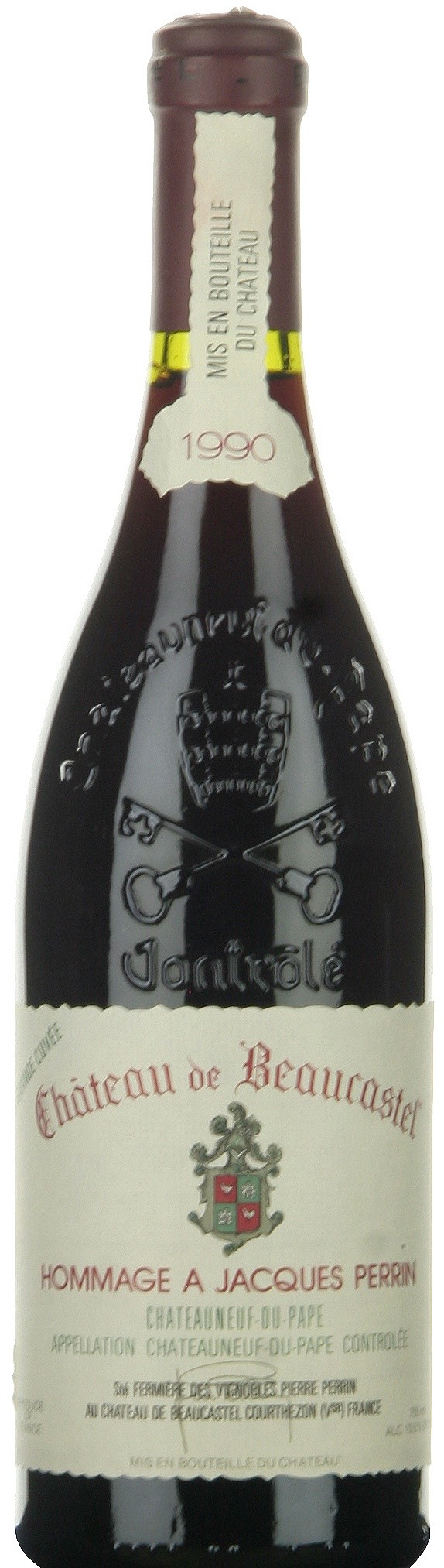
In a different style than the 1989, yet every bit as good, the 1990 Châteauneuf du Pape Hommage A Jacques Perrin checks in as a normal blend of 60% Mourvèdre, 20% Grenache, and the rest Syrah and Counoise, brought up in a large foudre. Resembling the 2000 with its forward, sexy style, it has awesome kirsch liqueur, blackcurrants, dry aged beef, Asian spice, and garrigue notes all literally jumping from the glass. As with the 1989, it’s fully mature, yet still has a stacked mid-palate, beautiful density and depth, and a seamless texture.
Serve at 16-18 °C with game, rich meat dishes.
About as sexy as this cuvee gets, the 1990 Châteauneuf du Pape Hommage À Jacques Perrin (60% Mourvedre, 20% Grenache, and the rest Syrah and Counoise) is spectacular. Similar in style to the 2000, it comes from a hot, dry vintage (and a big crop) that resulted in perfect ripeness and low acidity in most of the varieties. Full-bodied, supple, seamless and silky, with sweet tannin, it has awesome aromatics of kirsch liqueur, currants, Provençal herbs, meat juice and exotic spices all literally soaring from the glass.
Château de Beaucastel is one of the most renowned and prestigious wine estates in France, located in the legendary Châteauneuf-du-Pape appellation of the Rhône Valley. The estate belongs to the Famille Perrin, a family that has shaped the region’s winemaking history for more than a century and is today considered one of the most important ambassadors of Rhône wines worldwide.
The history of Beaucastel dates back to the 16th century, but the modern era of the estate began when the Perrin family took over the property in the early 20th century. Since then, Beaucastel has become a benchmark of quality not only in Châteauneuf-du-Pape but throughout France. The estate is known for its respect for tradition, deep attention to terroir, and a consistent philosophy of crafting long-lived, structured, and elegant wines.
The vineyards of Château de Beaucastel cover around 100 hectares, where all 13 traditional grape varieties permitted in Châteauneuf-du-Pape are cultivated. This is a rare and highly authentic approach that allows for the creation of exceptionally complex blends. The key varieties include ‘Grenache’, ‘Mourvèdre’, ‘Syrah’, ‘Counoise’, and ‘Cinsault’, though each variety plays an important role in shaping the final style of the wines.
The estate stands out for its unique soils, dominated by the famous galets roulés stones, which absorb heat during the day and release it at night. This natural phenomenon helps the grapes ripen evenly and gives the wines depth, concentration, and a distinctive mineral structure.
Since the 1970s, Château de Beaucastel has embraced organic and biodynamic viticulture, long before these practices became a global trend. No chemical treatments are used in the vineyards, and all grapes are harvested by hand to preserve maximum fruit quality and the authenticity of the terroir.
In winemaking, tradition is combined with precision: fermentation is carried out separately by grape variety, ageing takes place in large oak vats and barrels, and the final blend is crafted only after careful evaluation of each individual lot. This meticulous approach allows Beaucastel wines to achieve a remarkable balance between power, elegance, and longevity.
Château de Beaucastel wines are celebrated for their intense aromas, deep fruit expression, notes of spices and herbs, and firm tannic structure. They are regarded as some of the best ageing wines of Châteauneuf-du-Pape, often reaching their peak only after 10–20 years of maturation.
Today, Château de Beaucastel remains not only the pride of the Famille Perrin but also one of the brightest symbols of Rhône Valley winemaking – a true example of how tradition, terroir, and craftsmanship can create truly great wines.