The actual product may vary from the images shown on the website.
White dry
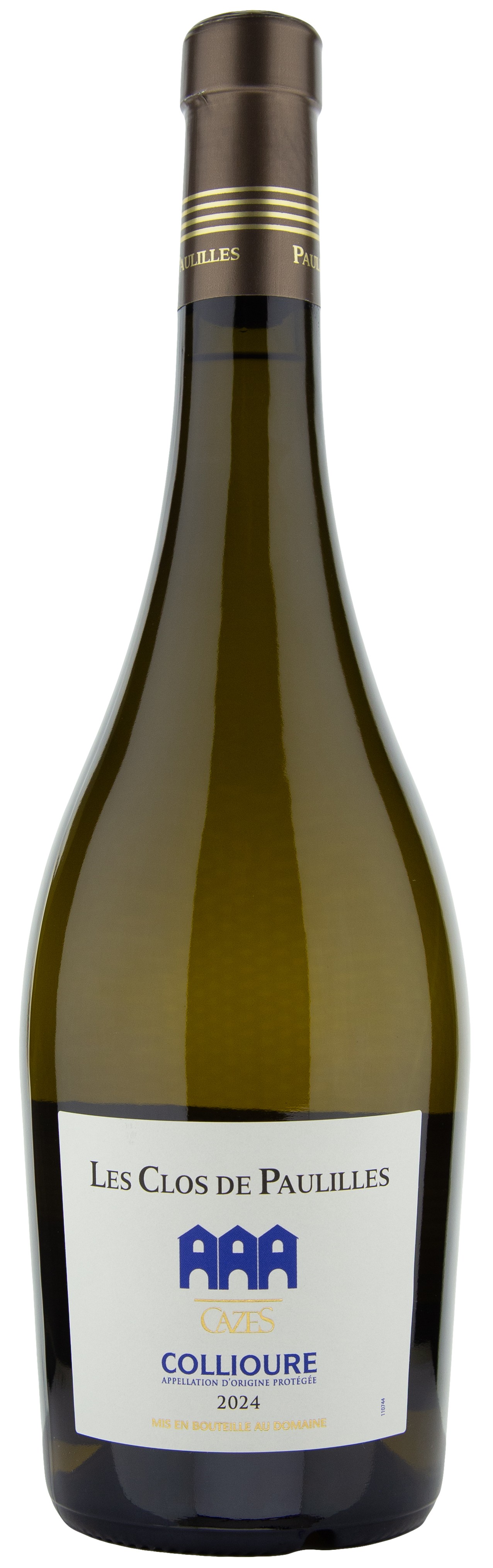
Domaine Les Clos de Paulilles Collioure Blanc 2024 is a dry white wine from the southernmost French appellation, Collioure AOC.
The aromatic palette is dominated by white peaches, ripe pears, citrus peels, and white flowers, harmoniously complemented by nuances of fennel, Mediterranean herbs, and smoky schist. On the palate, the wine reveals a concentrated, textural composition where ripe fruitiness transitions into a long, slightly salty finish characteristic of coastal wines.
The vines are grown on steep brown schist terraces rising above the Mediterranean Sea. The terroir, exposed to intense sun and constant coastal winds, gives the berries natural concentration while maintaining the necessary balance of acidity and freshness.
The wine is primarily based on Grenache Blanc and Grenache Gris grapes. The former provides the wine with weight and a round texture, while the latter brings freshness, minerality, and a distinct sensation of saltiness. Fermentation was carried out in stainless steel tanks, after which a portion of the wine was briefly aged on fine lees.
It is recommended to serve it chilled to a temperature of 10–12 °C. It pairs perfectly with grilled white fish, seafood (especially shrimp and squid), poultry, and soft cheeses.
Domaine Les Clos de Paulilles is one of the most characteristic and visually impressive wineries in the south of France, located between the Collioure AOC and Banyuls appellations, right on the Mediterranean coast. The winery is located around the Paulilles Bay, a wild, slate-clad area between the mountains and the sea, where the vines seem to hang over the water.
The history of the farm dates back to the early 19th century, when the Bernardi family founded the farm. Les Clos de Paulilles has become one of the most important names in the Roussillon region, renowned for its innovative approach to Banyuls and Collioure wines. It was this winery that was the first to produce and commercially introduce Banyuls “Rimage” style wines in 1975 – richer, fruitier, naturally sweet wines aged in a reductive environment. In 1989, the farm was also one of the first in the Collioure region to start using a higher proportion of ‘Mourvèdre’ and ‘Syrah’ in its blends, aiming to better express the local terroir.
In 2012, the winery was acquired by Maison Cazes, one of the most well-known names in biodynamic winemaking in the south of France. After this stage, even more active investments were made in organic winemaking, vineyard care and terroir expression. Today, a large part of the vineyards are certified as organic, and the entire farm is oriented towards sustainable farming and minimal intervention in the cellar.
Les Clos de Paulilles vineyards stretch on steep slate terraces, which are constantly exposed to strong sea winds and intense Mediterranean sun. This terroir gives the wines concentration, minerality and a characteristic salty character. The varieties typical of the south of France are mainly grown here – ‘Grenache Noir’, ‘Grenache Blanc’, ‘Grenache Gris’, ‘Mourvèdre’ and ‘Syrah’.
The winery’s style is based not on heavy extraction, but on a balance between sunny southern ripeness and maritime freshness. Both Collioure and Banyuls wines have a shale minerality, Mediterranean herbaceous aromas, ripe fruit concentration and expressive texture. These are wines that speak very clearly of the Côte Vermeille coast – the wild, hot and salty side of Roussillon.