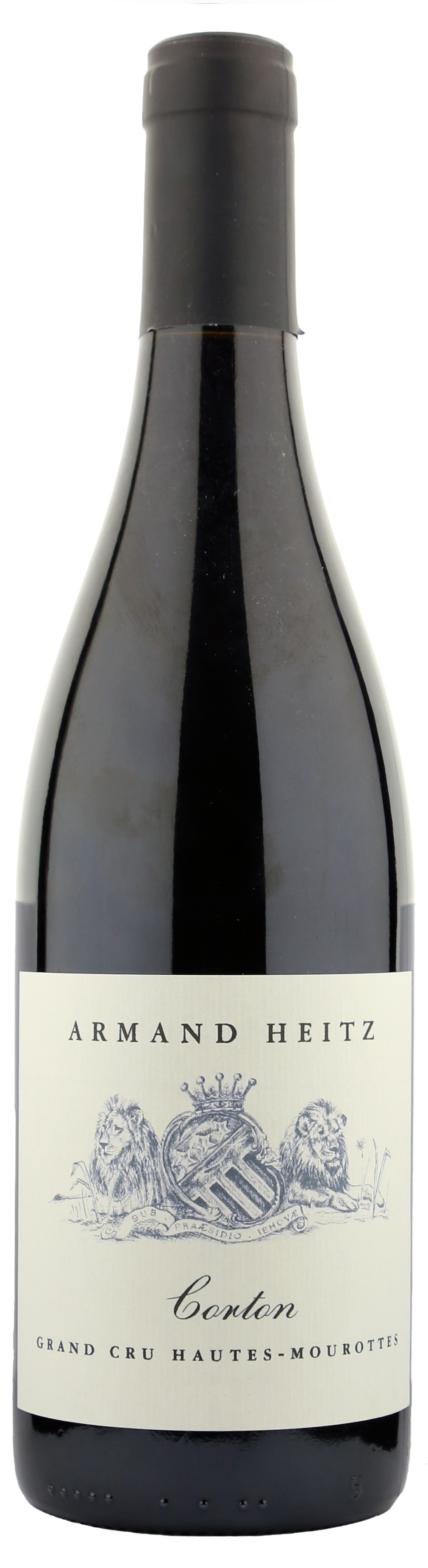
The actual product may vary from the images shown on the website.
Red dry
An interpretation of Les Chaumes by Armand Heitz from Corton Grand Cru – a small-production “Pinot Noir” whose 2020 vintage is marked by concentrated fruit, a dense texture and long ageing potential. Les Chaumes is located on the southern part of Corton Hill, on calcareous, stony soils, giving the wine a drier, mineral character alongside its ripe fruit profile.
The 2020 vintage in Burgundy was warm and early, resulting in pronounced notes of black cherry, raspberry and blackcurrant on the nose. These are complemented by violet, liquorice, sweet spice and subtle earthy tones. As the wine opens, the fruit becomes deeper, revealing more dried-herb and gently spicy nuances.
On the palate, the wine is dense, full and concentrated, while retaining sufficient freshness. The ripe dark-fruit character is supported by lively acidity, while firm, fine-grained tannins provide structure. The influence of the calcareous, stony subsoil of Les Chaumes is most evident on the finish, which is dry and mineral, with lingering notes of black cherry, liquorice, spice and subtle earthy nuances.
The wine is aged for 14 months in French oak barrels, around 40% of which are new.
Serve at 15–16 °C. Pair this wine with roasted duck breast with black cherry sauce, lamb loin with rosemary, or a risotto with wild mushrooms and truffles.
The hill of Corton is home to the only great red wines on the Côte de Beaune. It's a shame that Pommard didn't want to promote Rugiens and Volnay les Taillepieds. The term “Chaumes” has the same origin as “Charmes”: it indicates that it is an old piece of land that was fallow before becoming a vineyard. These place names would do well to inspire us to redesign our cultures.
History and tradition: the name of the climat refers to a piece of land that has been cultivated and then abandoned. The only appellation in the Côte de Beaune with Grand Cru status in red. Soil : at mid-slope, the gently sloping soil is reddish and stony, brown limestone, rich in marl with a high potassium content.
Armand Heitz is a biodynamic Burgundy wine estate based in Chassagne-Montrachet, actively producing wine under its own name since 2013. After completing his studies in Switzerland and several years of practical experimentation, Armand gradually took over the historic family vineyards, which for many years had been leased to Maison Drouhin, returning them to independent, terroir-focused winemaking.
Working closely with Ludovic Pierrot, long-time winemaker at Domaine Leflaive, Armand Heitz pursues a clear objective: to craft classically styled Burgundy wines where place, aromatic purity, and structural balance take precedence over technique. His philosophy aligns with benchmarks such as Domaine Leflaive and Domaine Ramonet—not through imitation, but through shared values and direction.
The estate follows biodynamic viticulture, prioritising low yields, soil vitality, and natural balance. Oak usage is deliberately restrained, with approximately 15–25% new barrels, ensuring clarity of texture and a transparent aromatic profile rather than overt oak expression.
Armand Heitz wines are defined by balance and a clear sense of origin.
White wines show distinct minerality, full yet precise texture, pure aromatics, and finely integrated oak.
Red wines are aromatic and juicy, with polished tannins and a dominant red-berry profile, achieved without excessive extraction.
The estate owns historic Burgundy vineyards, some acquired as early as 1857, including several of the region’s most renowned sites:
Meursault 1er Cru Perrières
Chassagne-Montrachet 1er Cru Têtes de Clos
Montrachet Grand Cru
Chevalier-Montrachet Grand Cru
Pommard 1er Cru Les Rugiens
Volnay 1er Cru Les Taillepieds
These are complemented by smaller but distinctive parcels in Chassagne-Montrachet, Meursault, and Pommard, allowing for a broad and nuanced interpretation of Burgundy terroirs.
A key strength of Armand Heitz Burgundy wines is their early approachability without sacrificing ageing potential. The wines are well balanced and enjoyable upon release, while their structural integrity and natural acidity allow them to develop gracefully over time.